Chapter 1
Chapter 1
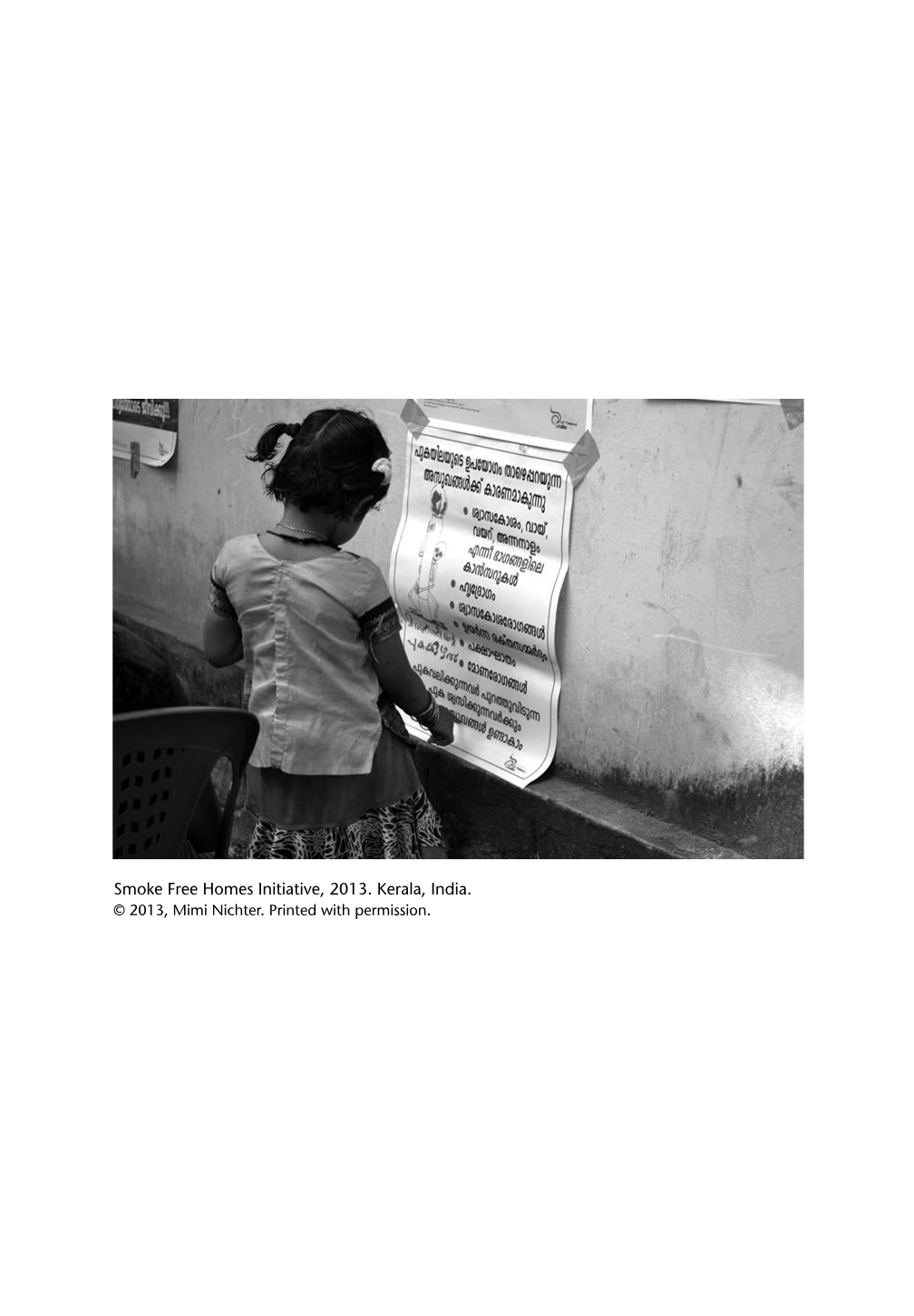
Tobacco-related mortality in India is among the highest in the world. In this photo, a young girl in Kerala State in South India reads a poster which explains the dangers of smoking and the harms of secondhand smoke to women and children. This social movement, spearheaded by anthropologists and public health specialists, has reached her village. In this poster and through various activities, community members are asked to join together and ban smoking inside their homes. As part of this intervention, school children are provided education about tobacco, and are asked to talk to their fathers about not smoking inside the home to protect their family members from the harm of secondhand smoke. Ethnographic research in Kerala, in which I was involved, revealed that daughters were able to "touch the hearts" of their fathers, and were able to convey a stronger message than their mothers. I took this photograph when I was working as a Co-Principal Investigator on Quit Tobacco India.
Six Bodily Resistances
Six Bodily Resistances
The body is a canvas, both physical and abstract, that is used to demonstrate who we are, where we belong and how we are taking a stand in the world. In this chapter, we deal with issues surrounding bodily resistances. We begin with the tensions inherent in acts of rebellion and resistance, and the desire for particular kinds of social belonging. Tensions are created via bodily rebellions at both the individual and social level, simultaneously creating difference and distance, as well as acceptance and inclusion. Tattoos, scarification, and circumcision are among the bodily practices that individuals use to signify something about themselves; so too are the ways we wear our hair, cover our bodies (or not), perfume ourselves, and otherwise decorate and manipulate our corporeal selves. In some instances, where an individual refuses to undergo a particular practice (female circumcision, for instance), the social risks are high even though the practice may increase other bodily risks. With each of the particular ways that individuals make these flexible, artistic, sometimes desperate statements about who they are, different constellations of bodily strengths and weaknesses are created that have both social and health implications. Identities are not constructed in isolation. They emerge in social networks that shape their way of being in the world in relation to each other, and to the institutions that they encounter.
Resistance is often directed at groups of people and institutions and the rules and regulations that they have put in place that shape people's lives through coercion or consent. Health care programs in particular have implications for the way people live their embodied lives. We are encouraged to eat less, move more, and refrain from smoking, and to engage in elaborate accounting mechanisms to ensure that our health care costs are reimbursed. In resisting such prescriptions and proscriptions, people make statements about authority, power and agency, and identity. Smokers cut themselves off from their 'non-smoker' friends, for example, while gaining friendship and belonging with the other 'smokers.' People with eating disorders learn new rules and ways of being within different social worlds where denying nourishment, binging, and purging are valued, while leaving behind the deeply social acts of sharing mealtimes and the sensual pleasures of savoring food. People may refuse medication and reject other behavioral prescriptions in acts of resistance to the particular subjectivity of the body to a diagnosis, its treatment regimes, and the power of medical practitioners, biomedicine, and often family. They may seek the support of others in their acts of resistance, or be influenced by social movements that encourage them to adopt certain health practices, while resisting others. Others embrace medical and surgical procedures in ways that defy normative views: the decision of a man or a woman to pay for a surrogate in order to parent is a resistance to hetero-normative and biologically based ideas of human reproduction. What can we learn about the ways that people act in response to medical and public health advice, and how they interact with health care institutions, and how and in what ways they resist?
Anthropology has a particularly strong history of theorizing small-scale rebellions and everyday acts of resistance, and describing the forms of resistance to biomedical ideas and practices has been an important trajectory of inquiry in medical anthropology over recent decades. It continues to be a fertile ground for research. In the end, one must ask, what does it matter? Does it do any good to resist? Who is harmed? And conversely, what is changed for the better? What new configurations of care can be imagined once the dominant 'health' paradigms have been challenged?
Anthropological studies of resistance provide us with a starting point to tease out the essential components of everyday forms of resistance that can then be applied to matters concerning health, healing, and bodies. In his now-classic volume, Learning to Labor: Why Working Class Kids Get Working Class Jobs, Paul Willis described the ways in which young men in the United Kingdom rebelled against formal schooling, and by doing so destroyed their chances for obtaining a good education and so the possibility of getting a job that was not tied to physical labor. The brilliance of Willis's work was in describing the verbal and non-verbal ways that these young men enacted their small rebellions with educational institutions that, in many ways, neglected their needs. The stated goal of the educators with whom Willis worked was to encourage youth to study hard, succeed in school, and so proceed, via university or other sorts of advanced training, to white-collar jobs-this goal was only partially conveyed to the working class 'lads.' By skipping school, dressing and talking in rebellious ways, and taunting those students who were good at their studies, the 'lads' sealed their own fate of failing high school. The lads' primary goal-to establish strong friendship networks while in high school, so that they would have friends on the shop floor when they went to work in factories-made good sense when looked at from their perspective. Studying took valuable time away from engaging in the kinds of adventures and 'larks' that created social bonding among their peers, which would be essential for their social survival at school and beyond school, once they had to start working as the breadwinners for their families. These young men had insight, if limited, into how the educational system worked. They knew they would never get high-paying jobs without degrees, but they also knew how to establish the social bonds-and so the social capital-that would allow them to get what they needed to survive in the world of industrial workers in nineteen seventies Britain. In addition, perhaps there was also a sharp understanding of the implications of class in Britain at that time: they probably would not have had an equal opportunity to gain employment in the areas of their training, even with a higher education, and so saw the futility of staying at school.
James Scott, in Weapons of the Weak, continued exploring and elaborating Willis's ideas of how less powerful groups in society have or don't have insight into how they are being controlled. Scott maintained that systems of power are rarely fully hegemonic. If, drawing on Gramsci's work, hegemony is defined as the material and ideological methods used to force, trick, or subtly pressure groups of people to comply and so ensure their consent or compliance, then resistances can be found and described at many levels. Hegemony is rarely, if ever, complete, as it is enacted through a mixture of control and consent. To truly create a revolutionary moment, people who are oppressed need to gain material and intellectual control over the ideas and the resources being used by those in power, and to take them for their own. These understandings of hegemony and everyday acts of resistance can be fruitfully applied to understanding bodily resistances as they are acted out via resistance to the dominant biomedical and social ideas of particular situations. Following Scott, such resistance may include foot-dragging, feigned ignorance, passivity, slander, and pilfering, and other similar acts,
providing often subtle ways of rebellion and subversion for people who lack formal avenues to oppose others' authority over their lives. As Sivaramakrishnan points out, the more complete analysis of protest includes not only everyday forms of resistance, but also an analysis of everyday enactments of power.
Biomedicine's hegemonic dominance varies by situation. While it is the primary form of curing in many resource-rich countries, and for those of the upper classes in poorer countries, many of the world's poorest people have limited access to biomedicine and further, depending on their health status and the information they have about various approaches to treatment, they may reject it as a curing option. Biomedical technologies generate their power through a nearly all-encompassing system of visualization, diagnosis, and bodily manipulation. The institution of biomedicine, in its fullest expression, is found in high-tech hospitals where patients can be monitored, controlled, and treated using this logic of healing. As the enactment of biomedicine moves further from resources of all kinds, its grip on the local logic of curing is loosened; its hegemony is diminished. Moreover, there are as many forms of biomedicine as there are places where it is being used. Resistance in each of those situations comes in different forms that are telling of the particularities of biomedical hegemony, local knowledge, traditions, resources, and inclinations.
A particular poignancy arises when considering acts of resistance in the context of ill health; the stakes are high, emotions accentuated. Acts of rebellion, resistance, dissimulation, and non-compliance can be seen variously as ill founded, ignorant, enlightened, or brave. To go against the locally accepted norms of maintaining health, being cured of a malady, or managing bodily processes elicits strong feelings from onlookers and puts the individual or groups of individuals engaged in the resistance into a fraught position, both bodily and socially. For instance, women in the United States and other heavily biomedicalized places who choose to give birth at home can be subjected to stories of risk to the health of their babies, ridiculed by biomedical practitioners with whom they come in contact, and censured for less than optimal birth outcomes. Legislation also controls what people can access or refuse, limiting the options available to them. Going against the norm, especially when it is a biomedical norm, puts individuals into the uncomfortable social position of asserting their right to control their bodies and to opt out of biomedicine's grip.
Aengst's work in Ladakh shows how women consciously resist local norms that prohibit out-of-wedlock sexual relationships. When women in this situation become pregnant, their private resistances are exposed bodily through their pregnancies. The women with whom Aengst worked tried to hide their pregnancies for as long as possible. The difficult choices the women faced-in the context of the highly negative stigma that their ex-nuptial pregnancies carried, included of shaming themselves and their families-led them to endure the risks of pregnancy without any medical attention and sometimes, tragically, taking on the responsibility of killing their child. Narratives of how women dealt with their competing needs of sexual pleasure and intimacy, in the absence of the protective elements of social acceptance of these acts and/or of effective birth control, are not unique to Ladakh, but they clearly show how a particular bodily act can put into motion both physical and social reactions that place individuals in extremely difficult situations.
Hilary Graham's research on the social ramifications of smoking provides a rather different perspective of resistance. The idea that smoking was a danger to women's health, and to their pregnancies, was just coming into the public conscience at the time of her original research, and women for the most part saw smoking as less a risk to themselves and their fetus than doing heavy housework or having sex in pregnancy. Women reasoned, too, that they would become irritable if they gave up smoking and this would cause problems with their spouses, families, and friends. Seen from this vantage point, the women's different assessment of health risks makes sense. In a later article, Graham wrote about a "backcloth of poverty" that shaped the choices women made, which included resistance to health messages to give up smoking. The women who smoked, in contrast to non-smokers, were less likely to have a friend in whom they could confide and had problematic relationships with their mothers; their partners were often unemployed, and they were worried about money. Tired, stressed, and lonely, women used smoking with a cup of tea or coffee to take time out from the work of caring. For these women, Graham argued, women's smoking made sense in the "hidden world of caring in poverty ... a cigarette can be the only purchase that women make, and (smoking) the only activity that women do, just for themselves."
In this chapter, the case studies illustrate situations where individuals rebel in ways that seem, on the surface, to be self-defeating; for instance, we see people rebelling against medical authority by continuing to smoke despite clear evidence of its impact on their health, and young women practicing self-starvation. These acts of resistance reveal what matters most to individuals and those with whom they identify and interact in particular circumstances. In the first case, Megan Wainwright describes a Uruguayan woman named Julia, who has chronic obstructive pulmonary disease, diabetes, cardiovascular disease, and an array of aches, pains, and sufferings. Her resistance to her doctor's command to stop smoking is couched in the fact that in her life she has given up many other things because of her medical conditions; she can no longer have sugar, salt, or bread. She draws the line at giving up her cigarettes too. Julia views cigarettes as her one 'guilty pleasure,' a pleasure that poses the least threat to her health. This is not a view shared by her physician or, over the years, by her husband.