Characteristics of true pathogenic fungi include:
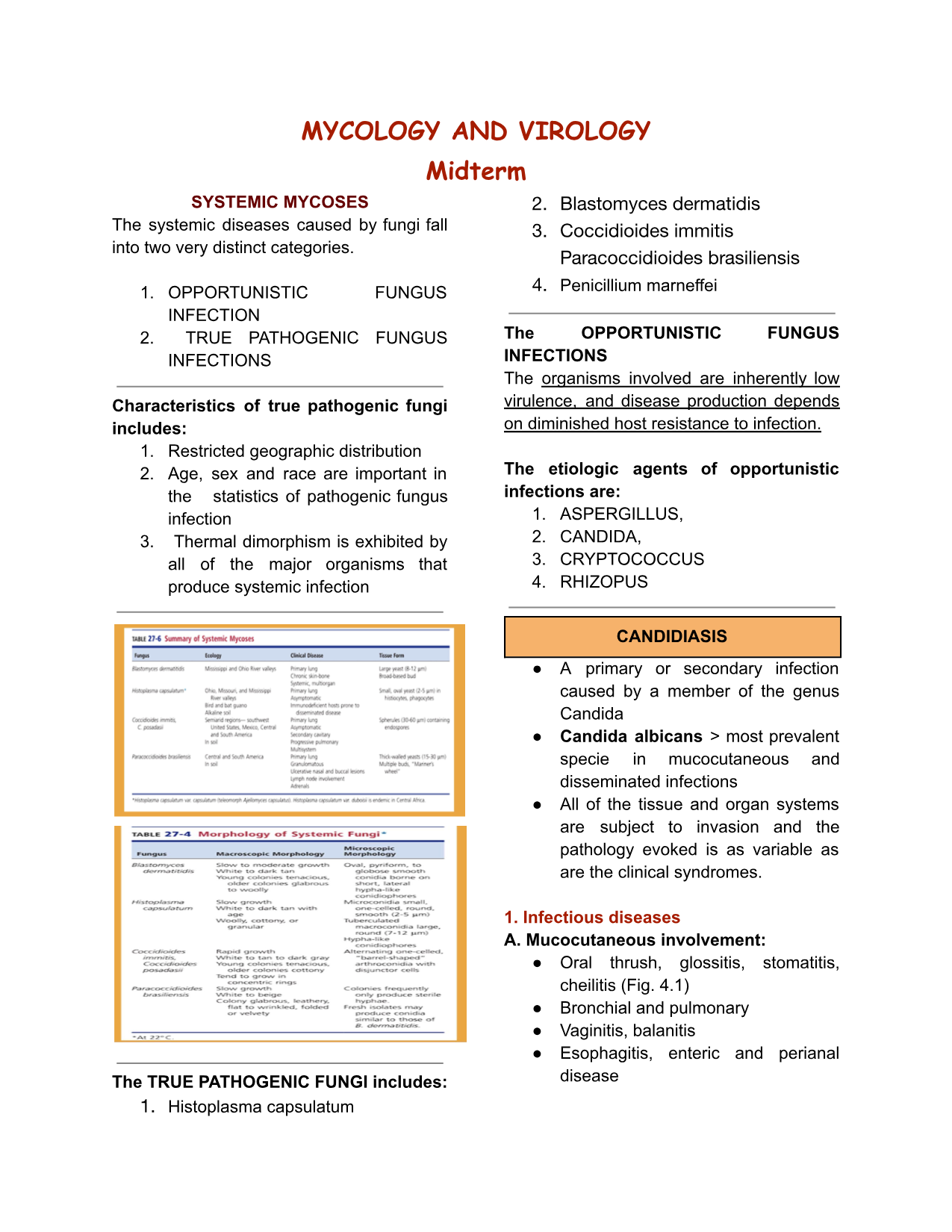
The true pathogenic fungi include:
The opportunistic fungus infections
The etiologic agents of opportunistic infections are:
Chronic mucocutaneous candidiasis (Fig. 4.2)
Laboratory identification
Proposed rapid identification of unknown yeasts
1. Allergy to Aspergillus antigen
2. Invasive aspergillosis.
Clinical forms of histoplasmosis
2. Opportunistic infection
Laboratory Identification
Differences between virus and cells
2. Helical symmetry (comes from the word helix which implies a coil)
Classification of medically important viruses
Stages of viral replication
3. Early viral mRNA synthesis
8. Progeny virion assembly
9. Virion release from the cell
2. Fusion of cells to form multinucleated cells
Typical in some families of viruses
3. Malignant transformation
Portals of entry are varied: depends on the specific virus
Most viral infections are either
2. Spread systemically throughout the body
Pathogenesis and Immunopathogenesis of certain viral infections
Envelope glycoproteins of Ebola virus
Clinical manifestation: diarrhea
There are other diseases in which cells are killed by immunologic attack. Exemplified by:
Characteristics of Parvovirus B19:
Pathogenesis of Parvovirus B19:
Vertical (mother to baby)
Manifestation: Erythema Infectiosum
Clinical Findings of Parvovirus B19:
A. Fever, malaise, U R T infection
Complications of Parvovirus B19:
Infections in Immunocompromised Patients:
Infections in Patients with Haemolytic Anemia.
Treatment of Parvovirus B19:
Human bocavirus, H B o V.
Outstanding characteristics:
Direct contact with infected material.
Molecular diagnosis: D N A hybridization tests
Outstanding characteristics:
Important model tumor viruses
1. Herpes simplex virus (H S V)
2. Varicella-zoster virus (V Z V)
3. Cytomegalovirus (C M V)
4. Epstein-Barr virus (E B V)
5. Human herpesvirus 6 (H H V 6)
6. Human herpesvirus 8 (H H V 8)
Eight human herpes that infect different organs
1. Herpes simplex virus (H S V 1)
H S V 1 or H S V 2 is a common cause of erythema multiforme
1. Herpes simplex virus (HSV-2)
HSV-I becomes latent in the sensory ganglion cells
The virus can be reactivated by a variety of inducers
Laboratory diagnosis: HSV-1, HSV-2
Laboratory diagnosis of H S V infections
B. Antibody neutralization/fluorescent antibody test
b. Varicellovirus - genera
Transmission: Respiratory droplets
c. Cytomegalovirus (genera)
Viral Capsid Antigen (VCA)
Human papillomavirus, H P Vs
Histopathology or Cytopathology
2. Histopathology and Immunohistochemistry
Immunoassays – E L I S A or E I A
H B s A g, Hepatitis B Surface Antigen